

So, optimising rest times for hypertrophy by getting stronger – is it possible? Enabling faster progressive overload, more weekly volume and therefore better strength and muscle size is the rhetoric. Henselmans and Schoenfeld 2014 state that a longer rest interval length may benefit muscle hypertrophy only if this allows for a higher total amount of work (work aka volume = sets x reps x weight). This is exactly what has been shown to be true in a preemptive study to this one below.
2. 3 Minute Rest vs 1 Minute Rest on Muscular Hypertrophy (Schoenfeld et al. 2016)
In this study:
- 21 young males
- All resistance training variables kept the same
The 3 minute rest group have shown to elicit superior hypertrophy gains compared to your conventional short rest time (1 minute) bodybuilding style training group. It is also important to note that both groups performed conventional hypertrophy style training, e.g 3 sets of 8-12 repetitions and performing a full body workout 3 times per week.
Results
- Muscle thickness was significantly greater for 3M in the anterior thigh and triceps brachii
- Maximal strength was significantly greater for both 1RM squat and bench press for 3M
These results could largely be down to increased volume as speculated in the second paragraph, as well as allowing for easier progressive overload (increasing the weight, reps, etc) to gradually increase muscular stress over time. The adaptive processes of the human body will only respond if continually required to exert a greater magnitude of force to meet higher physiological demands (Kraemer et al. 2004); therefore, the simplest thing we can do to address this is add weight to the bar. A longer rest time will aid with this.
3. 5 Minute Rest Time vs 1 Minute Rest Time on Hypertrophy (McKendry et al.2016)In this study:
- 16 young males were used
- 4 sets at 75% of 1RM
- Looking at anabolic hormonal response and total volume
Contrary to current research, 5M had a superior anabolic hormone secretion than 1M. 5M was also able to elicit higher workout volume as we can see in the image below. 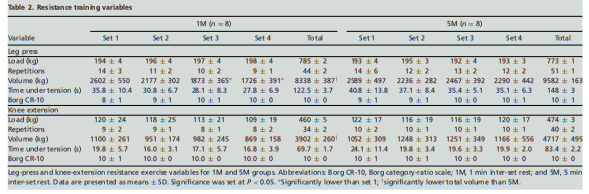
The increase in workout volume compared to 1M was due to less fatigue as we can tell by the 7 additional repetitions the 5M group performed. Being able to perform a higher volume workout routine may elicit better hypertrophy as Kraemer et al. 2004 states that greater hypertrophy is associated with high-volume, multiple-set programs thus justifying 5M is superior to 1M as it will catalyse high volume.
5. 2M vs 5M Rest Time for Hypertrophy (Ahtiainen et al. 2005)
Interestingly, as the short rest time is drawn closer to longer rest time, the results harbor substantially less potency.
- Experienced strength trained men
- No statistical difference was found
- 15% higher intensity for 5M group
The 2M group were able to perform more volume yet still no increase in hypertrophy, this suggests somewhere around 3 minutes should be the sweet spot for optimising volume, intensity and time efficiency for hypertrophy.
- Henselmans, M. and Schoenfeld, B.J., 2014. The effect of inter-set rest intervals on resistance exercise-induced muscle hypertrophy. Sports Medicine, 44(12), pp.1635-1643.
- Schoenfeld, B.J., Pope, Z.K., Benik, F.M., Hester, G.M., Sellers, J., Nooner, J.L., Schnaiter, J.A., Bond-Williams, K.E., Carter, A.S., Ross, C.L. and Just, B.L., 2016. Longer interset rest periods enhance muscle strength and hypertrophy in resistance-trained men. Journal of strength and conditioning research, 30(7), pp.1805-1812.
- McKendry, J., Pérez‐López, A., McLeod, M., Luo, D., Dent, J.R., Smeuninx, B., Yu, J., Taylor, A.E., Philp, A. and Breen, L., 2016. Short inter‐set rest blunts resistance exercise‐induced increases in myofibrillar protein synthesis and intracellular signalling in young males. Experimental physiology, 101(7), pp.866-882.
- Kraemer, W.J. and Ratamess, N.A., 2004. Fundamentals of resistance training: progression and exercise prescription. Medicine and science in sports and exercise, 36(4), pp.674-688.
- Ahtiainen, J.P., Pakarinen, A., Alen, M., Kraemer, W.J. and Häkkinen, K., 2005. Short vs. long rest period between the sets in hypertrophic resistance training: influence on muscle strength, size, and hormonal adaptations in trained men. Journal of Strength and conditioning Research, 19(3), p.572.
 Sam's Strength Sentiments